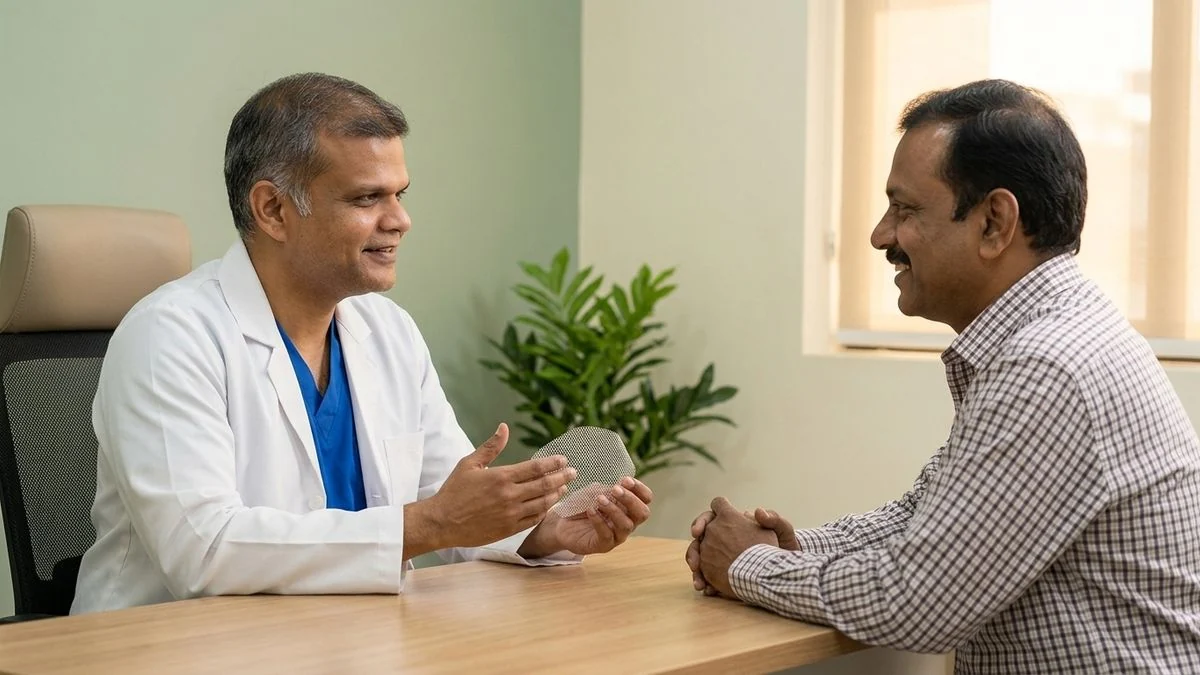
Hernia repair closes the weakness in the abdominal wall, usually reinforcing it with a mesh. Dr. Babu Elangovan repairs all common hernias by laparoscopic (keyhole) or open technique, relieving discomfort and preventing complications — often as day-care surgery.
Are You Dealing with a Painful or Growing Swelling?
A hernia occurs when an internal organ or tissue pushes through a weak spot in the surrounding muscle or connective tissue. You might notice a bulge in your abdomen or groin that becomes more prominent when you stand up, cough, or strain.
Unlike some minor muscle strains, a hernia does not heal on its own. Over time, the weakness in the muscle wall tends to stretch, causing the bulge to enlarge. While many hernias cause only mild discomfort, they carry a risk of serious complications, such as tissue entrapment or strangulation, which require urgent surgical attention.
Understanding the Different Types of Hernias
Hernias are classified based on where they occur in the body. Dr. Babu Elangovan evaluates and treats all common abdominal-wall hernias, tailoring the approach to your specific anatomy.
Inguinal Hernia: A bulge in the groin area, more common in men, often containing part of the intestine or fat.
Umbilical Hernia: A swelling near the belly button, frequently seen after pregnancy or due to abdominal strain.
Incisional Hernia: A bulge that develops at the site of a previous surgical scar where the abdominal wall has weakened.
Hiatus Hernia: A condition where the upper stomach slides up into the chest, often causing severe gastro-oesophageal reflux disease GERD.
How Laparoscopic Hernia Surgery is Performed
Laparoscopic hernia surgery is a minimally invasive technique that uses small keyhole incisions rather than a single large opening. This approach generally results in less postoperative pain and a quicker return to normal activities.
Anesthesia: The procedure is performed under general anesthesia to ensure you are completely comfortable and asleep.
Keyhole Incisions: The surgeon makes three small incisions, typically measuring less than a centimeter, in the abdominal wall.
Laparoscope Insertion: A thin tube with a camera, called a laparoscope, is inserted to provide a high-definition view of the hernia on a monitor.
Hernia Reduction: The protruding tissue or intestine is gently guided back into its proper position inside the abdomen.
Mesh Placement: A sterile, medical-grade mesh is positioned over the muscle defect and secured to reinforce the weakened area.
Closure: The small incisions are closed with dissolvable sutures or surgical tape, leaving minimal scarring.
Recovery, Diet, and Returning to Your Routine
Most keyhole hernia repairs are performed as day-care or short-stay procedures, allowing you to return home either on the same day or the following morning.
Hospital Stay: You will spend a few hours in the recovery room before being discharged with clear instructions on pain management.
Dietary Guidelines: You can resume a normal, fiber-rich diet immediately. Drinking plenty of water and eating fruits and vegetables helps prevent constipation, which reduces strain on the surgical site.
Physical Activity: Light walking is encouraged from day one to aid circulation. Avoid heavy lifting, strenuous exercise, or vigorous coughing for at least four to six weeks to allow the mesh to integrate securely.
Return to Work: Most patients can return to desk jobs or light duties within a week, while those with physically demanding roles may need more time.
Why Choose a Specialized Gastrointestinal Surgeon in Chennai?
Choosing a surgeon with dedicated training in gastrointestinal GI surgery and advanced laparoscopic techniques is key to achieving a successful outcome and minimizing recurrence.
Dr. Babu Elangovan brings over 20 years of clinical and operative experience to every procedure. With specialized training in minimal-access and robotic surgery, he ensures that the repair is meticulously tailored to your body's needs.
From your initial consultation at Mira Health Care in Adyar or Kauvery Hospital in Alwarpet, through your surgery and post-operative follow-ups, Dr. Babu Elangovan personally manages every step of your recovery. Patients travel from across Tamil Nadu and wider South India to access this dedicated, single-surgeon care, and remote video consultations are readily available for outstation patients seeking a trusted second opinion.
What to expect
1Clinical assessment
2Choosing keyhole vs open repair
3Mesh repair of the defect
4Day-care / short-stay recovery
5Follow-up
Hernia repair — watch & learn
GI & Liver Health Awareness
A general awareness video on gastrointestinal and liver health.
What is the difference between open and laparoscopic hernia surgery?
Open surgery uses a single larger incision directly over the hernia to place the mesh. Laparoscopic surgery uses three tiny keyholes and a camera, which typically results in less pain, smaller scars, and a quicker recovery.
How much does laparoscopic hernia repair cost in Chennai?
The cost depends on the type of hernia, the choice of mesh, the hospital room category, and whether it is a unilateral or bilateral repair. Most health insurance policies cover hernia repairs, and our team helps with pre-authorization.
Can a hernia go away without surgery?
No, a hernia will not heal on its own. While supportive garments can temporarily manage symptoms, surgery is the only definitive way to repair the muscle wall defect and prevent complications like strangulation.
What are the symptoms of a strangulated hernia?
A strangulated hernia is a medical emergency where the blood supply to the trapped tissue is cut off. Symptoms include sudden and severe pain, a bulge that turns purple or dark, nausea, vomiting, and an inability to pass gas.
How long is the recovery after inguinal hernia surgery Chennai?
Most patients return home within 24 hours. You can perform light daily activities within a few days and return to light office work in a week. Avoid heavy lifting for four to six weeks.
Is mesh always used in hernia repairs?
Yes, in almost all adult hernia repairs, a medical-grade mesh is used. Research shows that using a mesh significantly reduces the risk of the hernia returning compared to simple suture repairs.
How soon can I get an appointment or second opinion?
You can book an appointment with Dr. Babu Elangovan at Mira Health Care, Kauvery Hospital, or our other Chennai clinics. Remote video consultations are also available for outstation patients seeking a second opinion.
Hernia repair in Chennai
Dr. Babu Elangovan provides advanced laparoscopic hernia surgery across Chennai, consulting at Mira Health Care in Adyar, Kauvery Hospital in Alwarpet, Capstone Clinics in Nungambakkam, and Kumaran Hospital and THANC Hospital in Kilpauk.
Discuss hernia repair
Request a consultation and choose your preferred hospital. Enquiries reach Dr. Babu’s team and you are directed to the most suitable consulting location.