Barrett’s Esophagus: Can Long-Term Acid Reflux Lead to Cancer?
Need expert consultation? Book an appointment with Dr. Babu Elangovan.
Book AppointmentBarrett’s Esophagus: Can Long-Term Acid Reflux Lead to Cancer?
Yes — long-standing, poorly controlled acid reflux can change the lining of the lower food pipe into Barrett’s esophagus, a pre-cancerous condition that raises the risk of esophageal adenocarcinoma. That sentence needs two companions: Barrett’s is not cancer, and most people with Barrett’s never develop cancer — if surveillance and dysplasia treatment are taken seriously.
When heartburn needs a specialist visit is covered in acid reflux and GERD: when to see a specialist. Food lists live in GERD diet and trigger foods. This article owns the Barrett pathway — metaplasia, dysplasia, endoscopy, and cancer-prevention logic.
What Barrett’s esophagus actually is
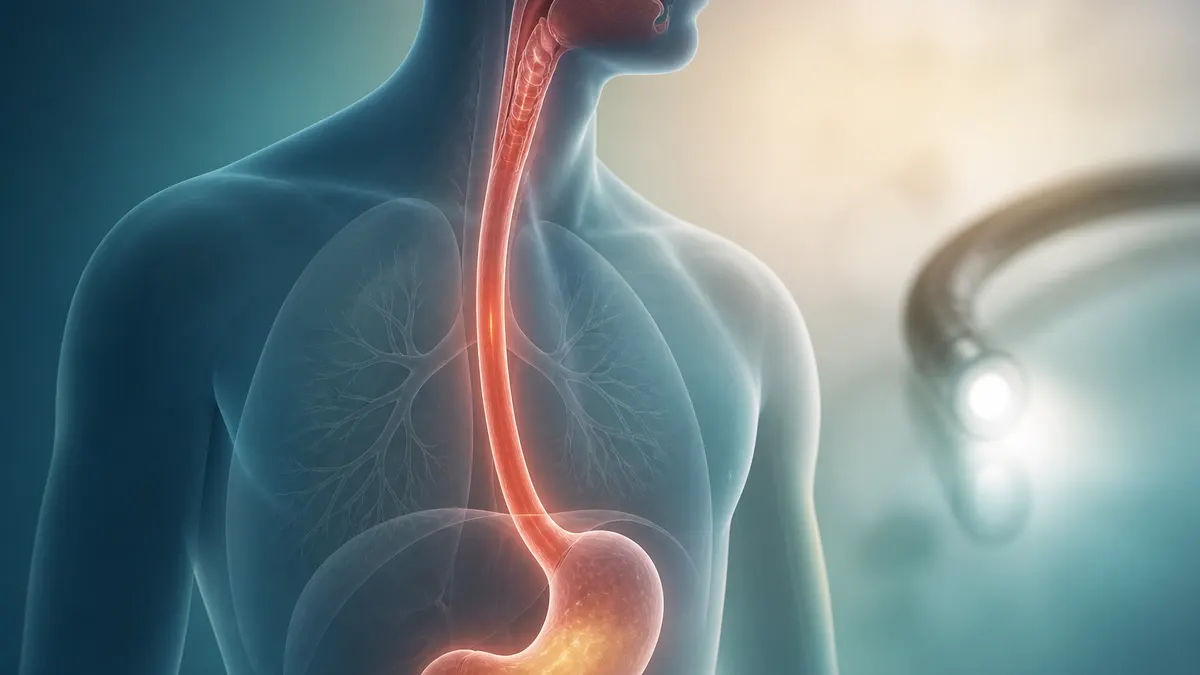
Normal esophageal lining is stratified squamous epithelium — pale and flat. In Barrett’s, it is replaced by columnar epithelium that looks more like intestinal lining (intestinal metaplasia), often recognised under the microscope by goblet cells.
The change is the body’s attempt to survive chronic acid and bile injury. The new lining tolerates acid better — which is useful for comfort and dangerous for vigilance, because symptoms may quiet while risk quietly remains.
How chronic GERD drives the change
GERD is not only occasional heartburn. When the lower esophageal sphincter allows repeated acid (and often bile) into the esophagus, chemical esophagitis follows. Years of repair in that hostile environment reprogram healing toward metaplasia.
Only a minority of people with GERD develop Barrett’s — commonly quoted in the order of roughly one in ten of chronic sufferers — but chronic uncontrolled reflux remains the dominant risk factor. Hiatus hernia, long symptom duration, male sex, age and central obesity add context your clinician weighs. Diet modulates daily acid load; it does not reverse established Barrett’s tissue on its own.
Pathway in one line:
Chronic GERD → esophagitis → intestinal metaplasia (Barrett’s) → dysplasia → adenocarcinoma (in a minority)
Symptoms — including the dangerous quiet
Barrett’s itself has no unique symptom. Discomfort comes from the underlying reflux. The clinical paradox: as metaplasia develops, burning may lessen because the new lining is less sensitive. Patients stop PPIs, skip follow-up, and assume they are cured. That is the opposite of what the biology asks for.
Alarm symptoms that need prompt assessment — not another antacid pack:
- Progressive difficulty swallowing (dysphagia)
- Painful swallowing
- Unexplained weight loss
- Vomiting blood or coffee-ground material
- Black stools
Stomach and colon cancer framing is separate — see early warning signs of stomach and colon cancer — but overlapping alarms still deserve endoscopy, not Google.
Diagnosis: gastroscopy and biopsy
You cannot diagnose Barrett’s from blood tests or “how you feel.” Upper GI endoscopy (gastroscopy) shows salmon-coloured mucosa extending above the gastroesophageal junction; systematic biopsies confirm intestinal metaplasia and grade dysplasia. Visual impression alone is not enough.
What the test feels like is covered in what to expect during a gastroscopy or colonoscopy; the service sits under GI endoscopy.
Length of the Barrett segment (short versus long) and whether tongues of mucosa are continuous or patchy also shape risk talk — longer segments generally carry higher progression rates, which is another reason the endoscopy report should describe anatomy carefully, not only “Barrett’s present.” Ask for the written report and the histology wording; “suggestive of Barrett’s” without goblet cells on biopsy is not the same as confirmed intestinal metaplasia.
Dysplasia grades — why the pathologist’s wording matters
| Grade | Meaning (plain language) | Typical direction of care |
|---|---|---|
| No dysplasia | Metaplasia present; cells organised | Surveillance endoscopy on a specialist schedule; optimise acid control |
| Low-grade dysplasia | Mild cellular atypia | Confirm with expert pathology review; closer surveillance or consider ablation |
| High-grade dysplasia | Severely abnormal, near-cancer biology | Active endoscopic therapy or surgical discussion — not passive watching |
Absolute progression rates are low for non-dysplastic Barrett’s and rise as dysplasia advances. The point of grading is to match intensity of care to biology — not to terrify every heartburn patient into believing cancer is inevitable.
Surveillance vs treatment (high-level — not a DIY calendar)
Surveillance means planned repeat endoscopy with biopsies at intervals your specialist sets from your dysplasia grade and risk profile. PPIs and lifestyle reduce acid injury; they do not replace endoscopy once Barrett’s is confirmed.
When dysplasia needs clearing, modern options include:
- Radiofrequency ablation (RFA) — controlled energy to remove the abnormal superficial lining so squamous tissue can regenerate
- Endoscopic mucosal resection (EMR) — lifting and removing nodular or suspicious foci for full pathology
Surgery (including anti-reflux fundoplication in selected reflux-driven cases, or esophageal resection when disease is advanced) enters when endoscopic therapy is unsuitable or cancer is already present. That pathway links to GI cancer surgery when needed — this post does not replace an oncology consult.
Do not invent your own “every five years” or “only if I burn” schedule. Symptom silence is unreliable.
Who should think about screening endoscopy
Not every occasional heartburn needs Barrett hunting. Candidates we take seriously include long-duration reflux (years, not weeks), frequent symptoms despite lifestyle change, erosive esophagitis on a prior scope, male patients with central obesity and long GERD, or anyone already told they have “salmon mucosa” without clear biopsy follow-up. The when to see a specialist post owns the heartburn triage; once Barrett’s is suspected or confirmed, the conversation shifts to dysplasia grade and calendar — this page’s job.
Cancer-prevention takeaways
- Treat chronic GERD seriously — specialist review when symptoms are frequent, long-standing, or masked by daily OTC use.
- Accept endoscopy when indicated; biopsy is the truth serum.
- If Barrett’s is confirmed, keep surveillance appointments even when you feel well.
- Treat dysplasia early with endoscopic therapy when advised.
- Stop smoking; limit alcohol; manage weight — they matter for reflux and cancer biology alike.
Acid control still matters after diagnosis: fewer acidic insults means less ongoing injury and clearer histology at the next biopsy (active inflammation can mimic low-grade dysplasia). That is optimisation — not a licence to skip the scope.
When to see a specialist in Chennai
Long-duration GERD, prior erosive esophagitis, known Barrett’s, progressive dysphagia, or a family history that worries you — bring prior endoscopy reports and biopsy wording. We will map risk, not recycle generic heartburn advice. If you have been self-medicating daily PPIs for months without a scope, that alone is a good reason to book — symptom control is not the same as mucosal safety.
Book an appointment or call +91 99626 60009.
This article is general information, not personal medical advice. Surveillance intervals and ablation decisions must be set by your gastroenterologist. Seek urgent care for vomiting blood, black stools, or food stuck with inability to swallow saliva.
Authored by