Foods That Trigger Acid Reflux — and When Diet Stops Being Enough
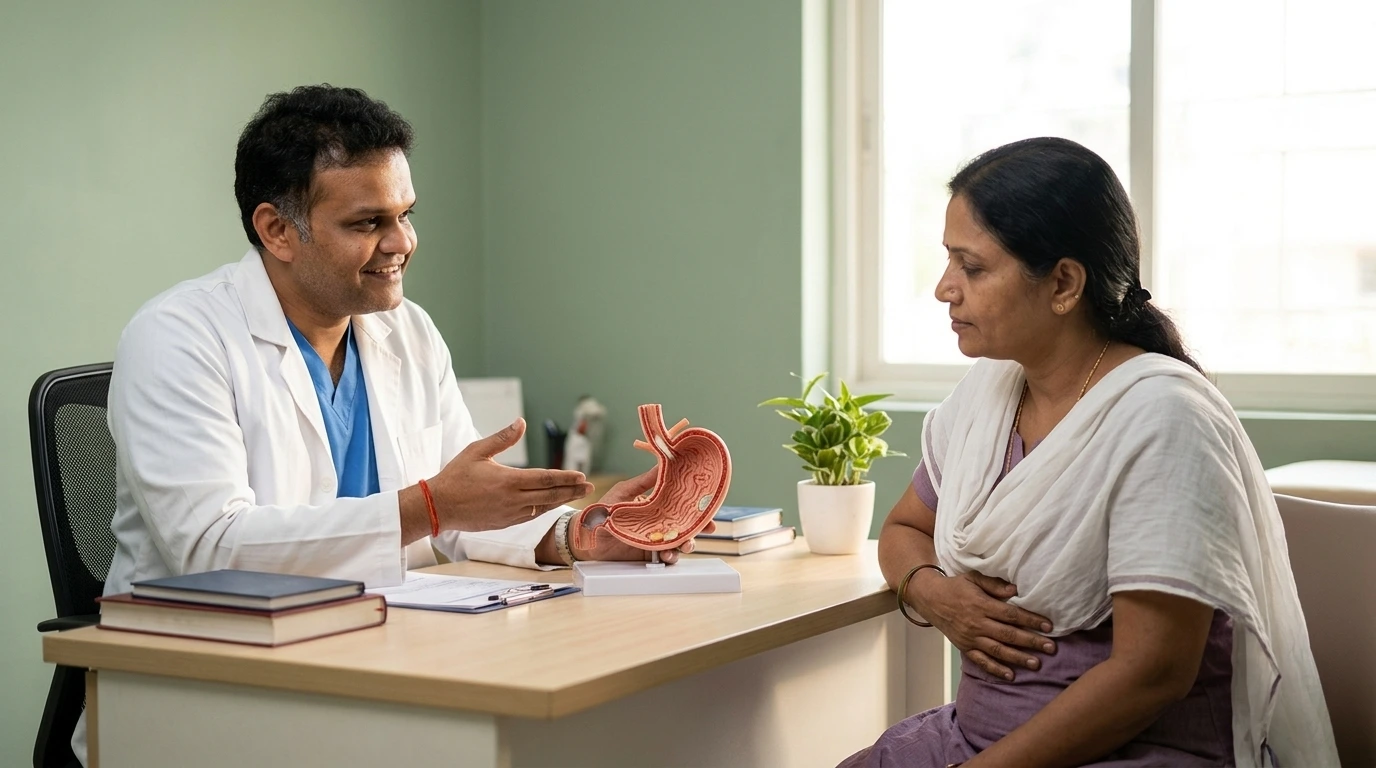
Need expert consultation? Book an appointment with Dr. Babu Elangovan.
Book AppointmentFoods That Trigger Acid Reflux — and When Diet Stops Being Enough
Most reflux advice online is a generic American list — tomatoes, citrus, chocolate — that ignores how people in Chennai actually eat. This is a more useful version, and it ends with the part that matters most: the point at which diet stops being the answer and you need an actual assessment.
Why reflux happens at all
Reflux is a mechanical problem more than a chemical one. At the junction of the food pipe and stomach sits the lower oesophageal sphincter (LOS) — a muscular ring that should stay shut and open only to let food through.
Two things defeat it:
- Something relaxes the sphincter — certain foods and drinks do this directly, through chemical effects on smooth muscle.
- Something raises pressure below it — a large meal, abdominal fat, a tight waistband, or lying flat.
That framing matters, because it explains why when and how much you eat often matters more than what. Symptoms and when they warrant a specialist are covered in acid reflux and GERD: when to see a specialist.
Food triggers, in an Indian kitchen
Deep-fried items — bhaji, vada, poori, bhature. Fat is the slowest macronutrient to digest, so the stomach stays full and pressurised for longer. Fat also triggers cholecystokinin release, which relaxes the LOS. Both effects push the same direction.
Excess ghee, butter, cream — the same mechanism, which is why rich gravies like butter masala or korma provoke symptoms even without chilli.
Chilli and heavy masalas. Capsaicin does not necessarily make you produce more acid. It slows gastric emptying and, more importantly, directly irritates an oesophageal lining that is already inflamed — so when acid does come up, it hurts considerably more.
Souring agents. Tamarind in sambar and rasam, tomato-heavy gravies, lemon and mango pickles. These add a direct acid load on top of your own stomach acid.
Raw onion and garlic — both relax the sphincter in susceptible people, though cooked forms are often tolerated better.
Chocolate — caffeine, theobromine, fat, and a serotonin effect, all of which relax the LOS. It is genuinely one of the worst offenders.
Mint. Counter-intuitive, since mint is sold as a digestive. Menthol relaxes smooth muscle — helpful for intestinal cramp, unhelpful at the sphincter.
Coffee and strong tea — caffeine relaxes the LOS, and taken on an empty stomach it stimulates acid with nothing there to buffer it.
Carbonated drinks — gas distends the stomach, and the resulting belch forces the sphincter open, carrying acid with it.
Alcohol — the worst of the group, because it does four separate things at once. That is covered in alcohol, acidity and GERD.
Habits that matter more than any food
If you change one thing, change this section rather than your grocery list.
The late dinner. Eating at 10pm and going to bed by 11 is standard in a great many Indian households, and it is probably the single largest driver of nocturnal reflux. Upright, gravity keeps acid down. Lying flat with a full stomach and a relaxed sphincter, acid pools and flows freely into the food pipe — for hours.
Large single meals. One big meal distends the stomach, stretches the junction and triggers sphincter relaxation. Two or three smaller meals with the same total food often produce far fewer symptoms than one large one. Portion and timing usually beat elimination.
Lying down after lunch. The post-meal nap is comfortable and reliably provokes reflux.
Tight waistbands — belts, shapewear, tight trousers all raise intra-abdominal pressure mechanically.
Weight around the middle, which does the same thing continuously.
Smoking, which both relaxes the sphincter and reduces saliva that would otherwise help clear acid.
What actually helps
- Finish eating three hours before lying down. The highest-yield change most people can make.
- Raise the head of the bed properly — 6 to 8 inches, using risers under the bed legs or a firm wedge under the mattress. Stacking pillows does not work: it bends you at the waist and increases abdominal pressure.
- Sleep on your left side. The stomach curves left, so in this position the junction sits above the acid pool rather than in it.
- Smaller, earlier meals rather than a strict elimination diet.
- Lose weight around the middle if that applies — it lowers the baseline pressure permanently.
- Stop smoking.
Three myths worth dropping
"Milk cures acidity." It soothes briefly, then the protein and calcium stimulate gastrin and acid production rises. Symptoms often return worse a couple of hours later.
"Cold drinks or curd will fix it." Cold liquid numbs the sensation temporarily. It changes nothing mechanically. Fresh curd is fine for most people; sour, over-fermented curd is not.
"Antacids are harmless, so I'll keep taking them." They are effective and have their place. Taking them daily for months without review is the problem — not because the drug is dangerous, but because it hides what is happening underneath.
When diet stops being enough
This is the section that makes this article worth reading rather than another recipe list.
See a doctor — do not simply increase your antacid — if you have:
- Symptoms more than twice a week despite diet changes and medication.
- Difficulty or pain swallowing, or food feeling like it sticks.
- Unintentional weight loss.
- Vomiting blood, or black tarry stools.
- Anaemia, or unexplained persistent fatigue.
- Reflux that wakes you at night.
- A need for daily acid suppression for months to stay comfortable.
Two of those deserve emphasis. Difficulty swallowing suggests a narrowing — a stricture from chronic acid damage, or something worse — and needs endoscopy rather than reassurance. Vomiting blood or black stools means bleeding, and needs same-day assessment.
Why long-standing reflux matters. After years of acid exposure, the lining of the lower food pipe can change into a more acid-resistant, intestine-like lining. This is Barrett's oesophagus. It often causes less burning, not more, which is exactly why it gets missed. It carries an increased risk of oesophageal cancer and needs periodic endoscopic surveillance once identified. It produces no symptoms of its own — endoscopy is the only way to find it.
What assessment actually involves
A gastroscopy takes a few minutes and shows the lining directly: whether there is oesophagitis and how severe, whether there is a hiatus hernia, whether Barrett's changes are present, and biopsies where needed. What the test is like is described in what to expect during a gastroscopy or colonoscopy, and the service in GI endoscopy.
For most people the answer is medication plus the timing and weight changes above. For a minority — those whose symptoms persist on proper treatment, who do not want decades of daily medication, or who have a large hiatus hernia — laparoscopic anti-reflux surgery is an option. That decision requires objective testing first, not just symptoms.
If this sounds like you
Persistent reflux is worth assessing properly rather than managing indefinitely from the pharmacy shelf. To discuss symptoms or arrange endoscopy, book an appointment or call +91 99626 60009.
This article is general information, not medical advice. Persistent reflux needs individual assessment, and long-term acid-suppressing medication should be reviewed by a doctor rather than continued indefinitely. Seek urgent care for vomiting blood, black stools, or difficulty swallowing.
Authored by