Laparoscopic Hernia Repair in Chennai: Mesh Surgery & Recovery
Led by Dr. Babu Elangovan · part of Hernia Surgery care
Laparoscopic hernia repair in Chennai by Dr. Babu Elangovan — TEP and TAPP keyhole mesh surgery, honest mesh safety answers, day-care discharge and recovery.
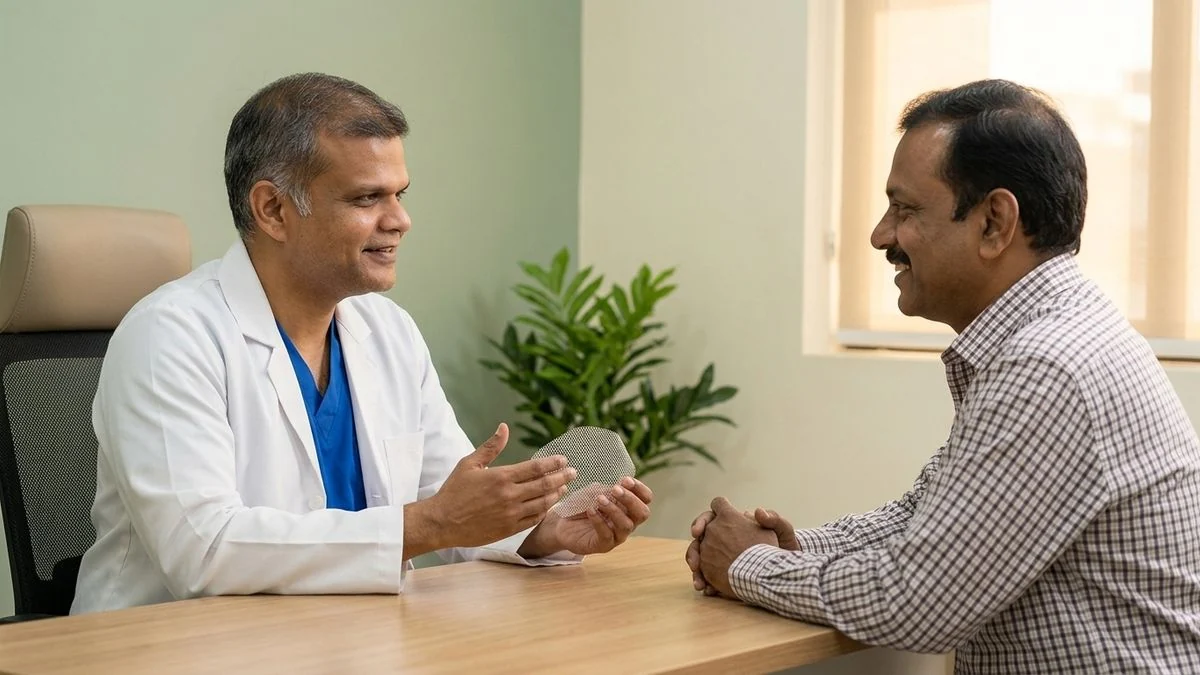
Laparoscopic Hernia Repair in Chennai: Mesh Surgery & Recovery
A hernia is a structural gap in the abdominal wall. It does not heal on its own, and surgery is the only repair. Dr. Babu Elangovan is F.M.A.S.-qualified in minimal access surgery and repairs all common abdominal-wall hernias by laparoscopic and open mesh technique, frequently as day-care surgery.
This page covers the repair itself — technique, mesh, cost and recovery. For the wider service and the range of hernias treated, see the hernia surgery speciality page.
Table of Contents
- Why hernias need repair
- Laparoscopic vs open mesh repair
- Repair by hernia type
- About the mesh
- Day-care surgery
- When a hernia is an emergency
- Cost in Chennai
- Recovery and recurrence
Why hernias need repair
A hernia happens when fat or a loop of bowel pushes through a weak point in the muscle and fascia of the abdominal wall. Because that is a mechanical defect rather than a soft-tissue strain, it cannot be closed by core exercises, physiotherapy or medication. Everyday intra-abdominal pressure — lifting, coughing, straining — keeps pushing against the gap, and over time the gap widens.
That progression is the argument for not waiting indefinitely. A small, easily repaired defect can become a large one containing multiple loops of bowel, with weaker surrounding muscle, a more complex operation and a higher chance of recurrence.
Watchful waiting has a genuine but narrow place: a small hernia causing no symptoms may reasonably be monitored under review. It is surveillance, not treatment, and it depends on knowing the emergency signs below.
Laparoscopic vs open mesh repair
Both approaches return the herniated tissue and reinforce the wall with mesh. They differ in access, recovery and suitability — and neither is universally better.
Laparoscopic (keyhole) repair works through three small incisions using a camera and fine instruments. There are two established routes:
- TEP (totally extraperitoneal) — the repair is done entirely in the space between the muscle layers without entering the abdominal cavity, which avoids handling the bowel. Favoured for standard groin hernias.
- TAPP (transabdominal preperitoneal) — the surgeon enters the peritoneal cavity and places the mesh behind the defect from inside. Useful for bilateral or complex hernias, and where trapped tissue needs direct inspection.
Open tension-free mesh repair remains the sounder option in defined situations: extensive scarring and adhesions from previous lower abdominal surgery, a very large or irreducible hernia, or cardiorespiratory disease that makes the carbon dioxide insufflation used in laparoscopy inadvisable. It can also be performed under spinal or local anaesthesia, which suits some patients better.
For complex or recurrent cases, robotic assistance can add dexterity and 3D visualisation; the general trade-offs are covered in robotic vs laparoscopic surgery and in the robotic and minimal-access surgery service.
Repair by hernia type
- Inguinal (groin) and femoral. The commonest hernias. A laparoscopic TEP or TAPP repair reinforces the whole myopectineal orifice — the shared weak area behind all groin hernias — with a single well-positioned mesh. Femoral hernias, more frequent in women, carry a higher strangulation risk and warrant prompt repair.
- Umbilical and paraumbilical. At or beside the navel. Very small defects may be closed with sutures; most are reinforced with mesh placed in the sublay position to reduce recurrence.
- Ventral and epigastric. Along the midline above the navel, repaired with mesh positioned to withstand high intra-abdominal pressure.
- Incisional. At the site of an earlier surgical scar where the wall failed to heal. These are often the most complex: large defects may need abdominal wall reconstruction, including component separation, to bring the muscles back to the midline before reinforcement.
- Hiatus. Anatomically different — the stomach moves up through the diaphragm rather than out through the abdominal wall — and repaired laparoscopically, often alongside an anti-reflux procedure where reflux is the dominant symptom.
Everyday keyhole abdominal surgery of this kind sits within the wider laparoscopic GI surgery service.
About the mesh
Patients ask about mesh more than anything else, so here are direct answers.
Why it is used. Before mesh, surgeons stitched the edges of the defect together. Because the tissue was already weak, those repairs sat under constant tension and the sutures could cut through, giving high recurrence rates. Tension-free mesh repair spreads load across the wall and lowers recurrence substantially. That is the entire reason it became standard.
What it is made of. Medical-grade, biocompatible monofilament polypropylene or polyester. Some designs are partly absorbable, leaving less permanent material once your own scar tissue has matured. Pre-shaped meshes follow the contours of the groin or abdominal wall without folding.
Will my body reject it? True rejection is very rare. The materials are chemically inert and designed to remain safely in the body for life without degrading.
Will I feel it? Once integrated into your tissue — usually 6 to 8 weeks — the mesh behaves as part of the abdominal wall and most people are unaware of it.
What about complications? Chronic discomfort and mesh infection are uncommon. They are minimised by careful dissection, strict sterile technique, and fixation using absorbable tacks, self-gripping mesh or surgical glue rather than rigid permanent tacks. Any persistent pain after surgery should be reviewed rather than endured.
Day-care surgery
Most uncomplicated laparoscopic repairs can be done as day-care surgery.
Admission is in the morning. Laparoscopic repair is performed under general anaesthesia, which gives the muscle relaxation the operation needs. Pain is managed with a multi-modal approach — local anaesthetic blocks placed during surgery, combined with non-opioid analgesia — which keeps grogginess and constipation down and gets you mobile sooner.
Afterwards you are monitored for roughly 4 to 6 hours. Discharge follows once pain is controlled on oral medication and you can take fluids, walk comfortably and pass urine. Bilateral or complex repairs, and patients with significant comorbidity, may need an overnight stay.
When a hernia is an emergency
Most hernias are soft, reducible and can wait for a planned operation. Occasionally that changes suddenly, and knowing the difference matters.
Incarceration — the contents become trapped outside the wall and can no longer be pushed back. It is not immediately life-threatening but it precedes what follows.
Strangulation — the neck of the hernia tightens enough to cut off the blood supply to the trapped tissue. Bowel can become gangrenous within hours, leading to perforation, peritonitis or sepsis. This is a surgical emergency.
Go to an emergency department immediately if:
- Pain at the hernia becomes sudden, severe or rapidly worsening.
- The bulge turns hard, very tender, or red, purple or dark.
- The bulge cannot be pushed back when you lie down.
- You develop nausea, persistent vomiting or marked abdominal bloating.
- You cannot pass gas or open your bowels.
Prompt treatment can be the difference between a straightforward repair and one requiring bowel resection. Our guide to when a hernia is an emergency covers these signs in more detail.
Cost in Chennai
Cost is not fixed, and a written estimate follows assessment. Published ranges for uncomplicated laparoscopic hernia repair in Chennai fall broadly around INR 65,000 to INR 1,60,000, and the variables that move it are:
- Unilateral vs bilateral — repairing both groins takes longer and uses more material.
- Mesh and fixation — lightweight, dual-sided, anatomical or self-gripping meshes differ in cost.
- Laparoscopic vs open — different theatre time and consumables.
- Complexity — a simple inguinal repair sits at the lower end; a large recurrent incisional hernia needing abdominal wall reconstruction sits well above it.
- Hospital and room category — theatre, room and nursing charges vary by facility.
Insurance. Hernia repair is medically necessary rather than cosmetic, so it is covered by most private health insurance and corporate policies. The team coordinates pre-authorisation with hospital insurance desks for cashless treatment. Eligible patients may be covered under the Tamil Nadu Chief Minister's Comprehensive Health Insurance Scheme (CMCHIS) at empanelled hospitals; confirm eligibility before admission.
Recovery and recurrence
Recovery is paced to protect the repair while the mesh integrates.
| Timeline | Usually possible | Avoid |
|---|---|---|
| Days 1–3 | Gentle walking indoors, breathing exercises | Lifting over ~2 kg, straining |
| Week 1–2 | Desk work, stairs, short drives | Heavy lifting, sudden twisting |
| Week 3–4 | Normal routine, light jogging | Gym loading, lifting over ~5 kg |
| Week 6+ | Full activity and sport, once cleared | — |
These are typical milestones, not rules; your surgeon's advice for your repair takes precedence. The day-by-day detail, including wound care, sits in our recovery after laparoscopic hernia surgery timeline guide.
Reducing the chance of recurrence:
- Respect the lifting restriction for the full 6 weeks — this is the one most often broken.
- Treat a chronic cough, since repeated coughing loads the healing repair.
- Avoid constipation with fibre and fluids, to prevent straining.
- Manage weight, which lowers constant pressure on the repair.
- Stop smoking, which impairs tissue healing.
Consult Dr. Babu Elangovan
Dr. Babu Elangovan is a surgical gastroenterologist with over 20 years of experience and F.M.A.S. qualification in minimal access surgery, repairing inguinal, umbilical, incisional, ventral and hiatus hernias by keyhole and open technique.
How the consultation works: send your reports through the booking form or WhatsApp; Dr. Babu reviews them, usually the same day, and the team confirms a slot at the most convenient Chennai location.
To have a hernia assessed or discuss a planned repair, book an appointment or call +91 99626 60009.
This page is general information, not medical advice. Which technique suits you depends on individual clinical assessment by a qualified surgeon. Outcomes vary between patients and cannot be guaranteed. If you have signs of a strangulated hernia, seek emergency care immediately rather than waiting for an appointment.
Frequently Asked Questions
Is hernia mesh safe?
Modern surgical mesh has a well-established safety record. It is made from biocompatible, chemically inert monofilament polypropylene or polyester designed to stay in the body for life without degrading. True rejection is very rare. The mesh works as a scaffold that your own collagen grows into, so once integrated — usually within 6 to 8 weeks — most people cannot feel it. Complications such as chronic discomfort or infection are uncommon and are minimised by careful technique, sterile protocol and appropriate fixation. Mesh matters because tension-free repair substantially lowers recurrence compared with stitching a weakened muscle edge under tension.
Can a hernia be cured without surgery, with exercise or a belt?
No. A hernia is a structural gap in the muscle and fascia, not a strain, so it cannot close on its own and no exercise, physiotherapy or medication will repair it. A truss or belt may briefly mask the bulge but does nothing to fix the defect and can make matters worse. For a small hernia causing no symptoms, watchful waiting under review is sometimes reasonable, but it is monitoring rather than treatment — surgery is the only repair.
Is laparoscopic repair always better than open surgery?
No, and it is worth being clear about this. Keyhole repair generally means less post-operative pain and a faster return to work, and it suits bilateral and recurrent groin hernias well. But open tension-free mesh repair is the safer choice in specific situations: dense adhesions from previous lower abdominal surgery, a very large or irreducible hernia, or cardiorespiratory conditions that make the carbon dioxide used in laparoscopy inadvisable. The right technique is chosen from your anatomy and health, not by default.
Can I go home the same day?
Often yes. Uncomplicated laparoscopic repairs are frequently done as day-care surgery: morning admission, then 4 to 6 hours of monitored recovery. Discharge follows once pain is controlled on oral medication and you can take fluids, walk comfortably and pass urine. More complex or bilateral repairs, and patients with significant comorbidity, may need an overnight stay.
When can I lift weights or return to the gym?
Light walking starts immediately and desk work usually resumes within one to two weeks. Heavy lifting, gym training and contact sport are generally avoided until about 6 weeks, once the mesh has integrated and the surgeon confirms healing. Rushing this is one of the avoidable causes of recurrence. Our detailed recovery timeline guide sets out the week-by-week milestones.
Related procedures
Consult Dr. Babu Elangovan in Chennai
Get an expert surgical opinion on laparoscopic hernia repair — from diagnosis and planning through to recovery, with the same surgeon at every step.