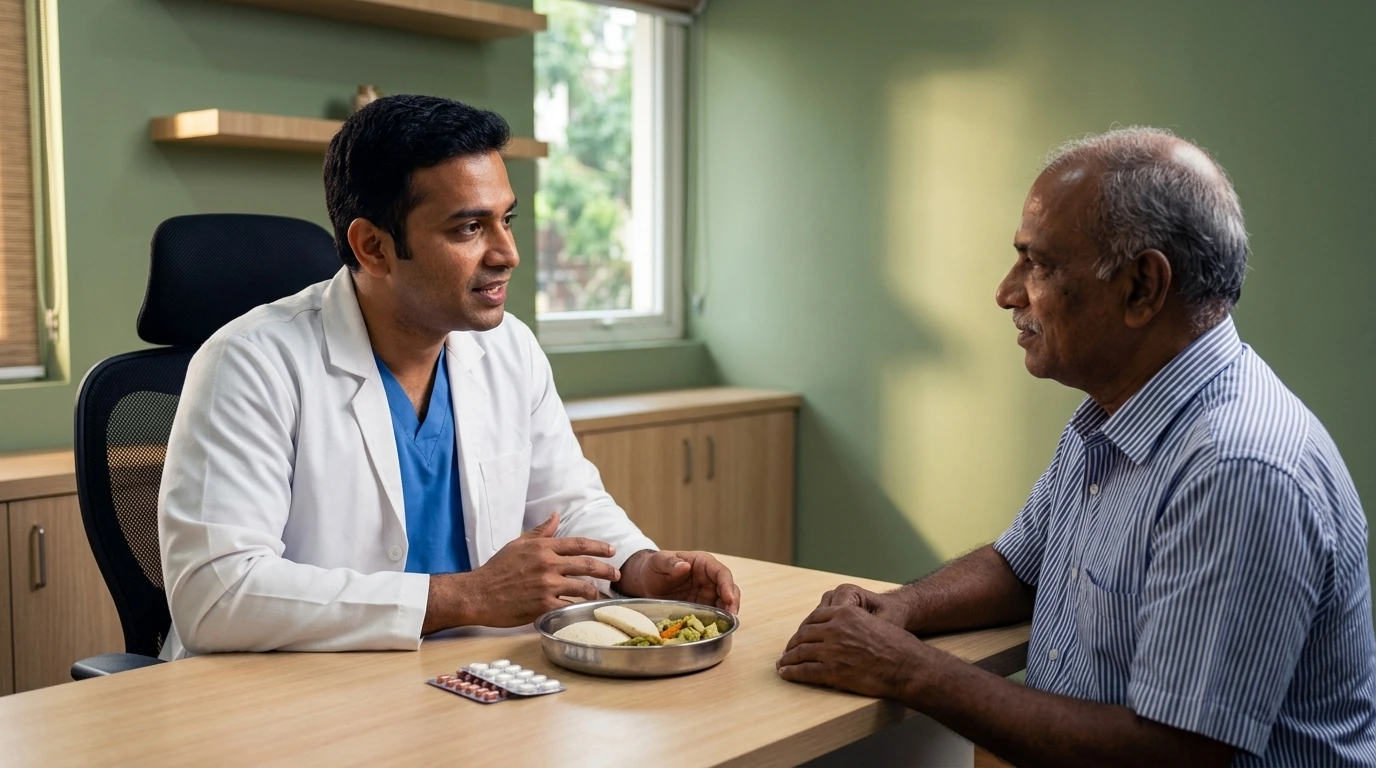
Protein, Muscle Loss and Indian Vegetarian Eating After Bariatric Surgery

Need expert consultation? Book an appointment with Dr. Babu Elangovan.
Book AppointmentProtein, Muscle Loss and Indian Vegetarian Eating After Bariatric Surgery
Most post-bariatric nutrition advice assumes chicken, fish and eggs. For the substantial number of patients in Chennai who eat vegetarian, that advice is close to useless — and the gap is not trivial, because protein is the one nutrient that determines whether you lose fat or lose muscle.
This is the honest version of that problem, and what to do about it.
Why protein becomes the priority
After surgery you lose weight quickly. The aim is that the weight lost is fat, and that muscle is preserved. That is not automatic. If protein intake falls short, the body breaks down its own muscle to obtain the amino acids it needs for healing, immunity and basic function.
Losing muscle matters for three reasons:
- Your metabolic rate falls. Muscle is metabolically active tissue; less of it means fewer calories burned at rest, permanently. That makes weight regain more likely in years two and three.
- You feel weak and tire easily, which undermines exactly the activity that would help.
- Healing slows, since tissue repair runs on protein.
With a stomach reduced to roughly the size of a small teacup, every mouthful has to earn its place. Protein has to be planned deliberately or it simply does not happen.
The Indian vegetarian problem, stated plainly
Here is the part that gets glossed over.
A typical Indian vegetarian diet is carbohydrate-dominant — rice, roti, potato — and its main protein sources are dal, rajma, chana. These are genuinely good foods. But they are relatively dilute in protein per unit of volume, arriving packaged with a good deal of carbohydrate and water.
Before surgery that was fine: you could eat enough volume to reach your protein needs. After surgery, volume is the binding constraint. Fill a very small stomach with dal and rice and you will feel completely full having taken in only a modest amount of protein.
Do that consistently and you get steady protein shortfall, muscle loss, fatigue and hair shedding — while eating what looks like a perfectly reasonable diet. This is not a failure of effort. It is arithmetic, and it needs a deliberate shift toward density over volume.
Denser options that work
Roughly ordered by protein per unit volume:
| Food | Why it works |
|---|---|
| Whey or plant protein isolate | Highest density; often needed early on. Choose isolate over concentrate on your dietitian's advice |
| Paneer (low-fat) | Dense, complete protein, versatile, easy to chew soft |
| Hung curd / Greek-style yoghurt | Denser than regular curd, smooth, well tolerated |
| Soya chunks / granules | Very high density — must be soft-cooked and finely minced |
| Tofu | Complete plant protein, soft, easily digested |
| Egg whites (if eggetarian) | Almost pure protein, no fat or carbohydrate |
| Sprouted legumes | Better digestibility than unsprouted, still bulky |
| Besan | Useful as a fortifier in batters rather than eaten alone |
Fortifying beats substituting. Adding skimmed milk powder to curd, or besan to a batter, raises protein without changing the food into something unfamiliar — far more sustainable than expecting someone to abandon their normal diet.
Practical strategies
- Protein first, always. Eat the protein portion before touching rice, roti or vegetables. If you run out of room — and you will — you will have already had the part that matters.
- Separate fluids from solids by about 30 minutes each side. Drinking with meals fills scarce space with no protein and can provoke dumping.
- Small, frequent meals — five or six a day rather than three.
- Chew thoroughly, to a near-puree. Your teeth now do work the stomach used to do.
- Fortify what you already eat rather than adopting unfamiliar foods you will abandon in a month.
Deficiencies that matter especially for vegetarians
- Vitamin B12. Already commonly low in Indian vegetarians, and surgery makes it worse — reduced stomach acid impairs absorption, and bypass procedures skip part of where it is absorbed. This one needs lifelong attention.
- Iron. Plant (non-haem) iron is poorly absorbed to begin with, and reduced stomach acid makes conversion to the absorbable form harder. Iron-deficiency anaemia is common and produces exactly the fatigue and hair loss people attribute to the surgery itself.
- Calcium and vitamin D. Absorption falls; over years, bone density suffers. The form of calcium matters here — your team will prescribe accordingly.
All of these need periodic blood monitoring, not a general multivitamin and hope. Doses are individual and prescribed, which is why none are given here.
The other half: resistance work
Protein supplies the raw material; physical stimulus tells the body to keep the muscle. Walking is excellent for general health and cardiovascular fitness but is not, on its own, a strong enough signal to preserve muscle mass.
Some form of resistance work — bodyweight movements, bands, light weights — makes a real difference. Timing and clearance come from your surgical team; do not start before you are cleared.
Warning signs to report
- Unusual or worsening fatigue — often the first sign the body is breaking down muscle
- Hair shedding continuing past six months (some shedding at months 3–6 is expected and settles)
- Brittle nails, dry or poorly-healing skin
- Swelling of ankles or feet — can indicate significant protein deficiency
- Breathlessness or pallor — suggests anaemia
- Frequent infections or slow recovery from minor illness
None of these should be quietly tolerated as "part of the process". They are all correctable once identified.
The programme matters as much as the operation
Long-term results after bariatric surgery track follow-up more closely than they track surgical technique. Protein targets change through the first year, supplement doses need adjusting against blood results, and a dietitian who understands Indian vegetarian cooking is worth considerably more than a generic meal plan.
For the operation itself see sleeve gastrectomy, the choice between procedures in sleeve gastrectomy vs gastric bypass, eligibility in am I eligible for weight loss surgery, and the wider service under bariatric and metabolic surgery.
To discuss post-surgical nutrition or arrange review, book an appointment or call +91 99626 60009.
This article is general information, not medical advice. Protein targets and supplement regimes after bariatric surgery are individualised by your bariatric team and dietitian, and blood levels need periodic monitoring. No doses are given here deliberately — they are prescribed, not generic.
Authored by